
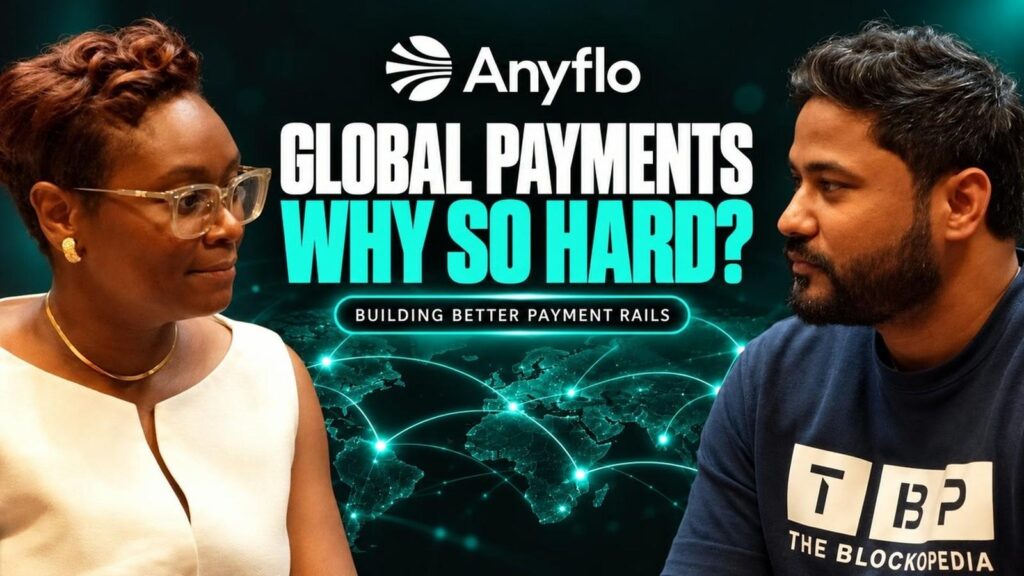
Stablecoins can move money around the world in seconds. Yet for most businesses, paying a supplier or contractor in another country is still slow, costly and hard to explain to an accountant. According to one founder, the problem is not the technology. It is the missing layer between blockchains and the way ordinary businesses work.
On the sidelines of Token2049 in Singapore, Mohammad Ahmad Khan, co-founder of The Blockopedia, sat down with Lola Oyelayo-Pearson, Founder and CEO of Anyflo, for the TBP Podcast. Lola spent nearly four years at Mysten Labs, the original contributor to the Sui blockchain, after roles at Shopify and Capital One. Over 18 minutes, they covered the three problems Anyflo wants to solve, where it stands today, why Anyflo uses Sui but stays multi-chain, security, and why so few women reach the core of the industry.
Key Takeaways
- Anyflo is building payment rails that let everyday businesses move money across borders on stablecoin rails, with fiat in and fiat out if they want it.
- Lola names three problems: slow and costly cross-border money, fiat-to-fiat transfers through a “stablecoin sandwich”, and receipts that accountants and regulators can follow.
- Anyflo is not fully live. It is testing with design partners in payroll, retail and travel, and banking, and hopes to secure an EU payments licence in the new year.
- Her main lesson for crypto builders: “token go up is not a business model”. Teams that do not understand fiat rails have high potential but limited reach.
- Anyflo leans on Sui for zero-gas stablecoin transfers but stays multi-chain. In her words, it locks customers into an outcome, not a blockchain.
- She says no founder can promise never to be hacked. Anyflo is audited and keeps each customer’s funds separate.
From an agency to Mysten Labs: the road to Anyflo
Lola says she has always been described as entrepreneurial. In every job, her approach was to work out the problem, then build what was needed to solve it. Before Shopify, she was at Capital One. Before that, she worked at another blockchain startup, and earlier she ran an agency that was later sold to Cognizant. According to Anyflo’s website, she led teams at Shopify Money and Capital One UK, and was GM of Commerce and Consumer Product at Mysten Labs.
The idea grew out of her time at Mysten Labs working on Sui. She met many companies that wanted to use stablecoins, but no supply chain existed to service them. “It’s one thing to have the L1 and the infrastructure,” she says. To make it real, it has to be plugged into everyday businesses.
She calls Anyflo the company she wishes she could have introduced to firms from her past roles, naming Red Bull, Adidas and Lyft (they are not Anyflo customers). This year, she says, she took the chance: “we are building the payment rails to bring stablecoins to everyday businesses.”
The three problems Anyflo solves for businesses
Individuals who use stablecoins, Lola says, are usually comfortable with a self-custody wallet, an exchange or a decentralised exchange (DEX). Businesses are different. “When you are a business, you have hundreds of interfaces,” she says. To move money between many customers, suppliers and partners, “self-custody doesn’t work. Exchanges don’t work.”
Businesses must also meet rules on sanctions and money laundering and know where money is going. So “even the idea of using a decentralised exchange is incredibly scary”, she says, before anyone mentions hacks.
What businesses need, she argues, is a supply chain that understands how they operate. Anyflo’s pitch is to be that layer, aimed at three problems:
1. Cross-border money. Doing it in fiat is expensive and slow. Anyflo lets businesses do it on stablecoin rails.
2. Fiat in, fiat out. Some businesses want stablecoin speed but do not want to hold stablecoins. Anyflo supports a “stablecoin sandwich”: the payment starts in fiat, crosses on stablecoin rails and ends in fiat.
3. Records an accountant can understand. Instead of links to a block explorer, the business gets a receipt showing who sent what to whom and the route the money took, which auditors or regulators can also check.
“Those three things, they sound really easy, they’re very, very hard if you’re a business today,” Lola says. Few firms can offer this to a global audience, she adds, “not just US via Stripe and Bridge”.
Where Anyflo stands today
Ahmad asks what changes early partners have seen. Lola is direct: no partners are transacting fully yet. Anyflo has customer design partners who represent the needs it is designing for, in three areas:
- payroll
- retail and travel
- a modern banking-type solution
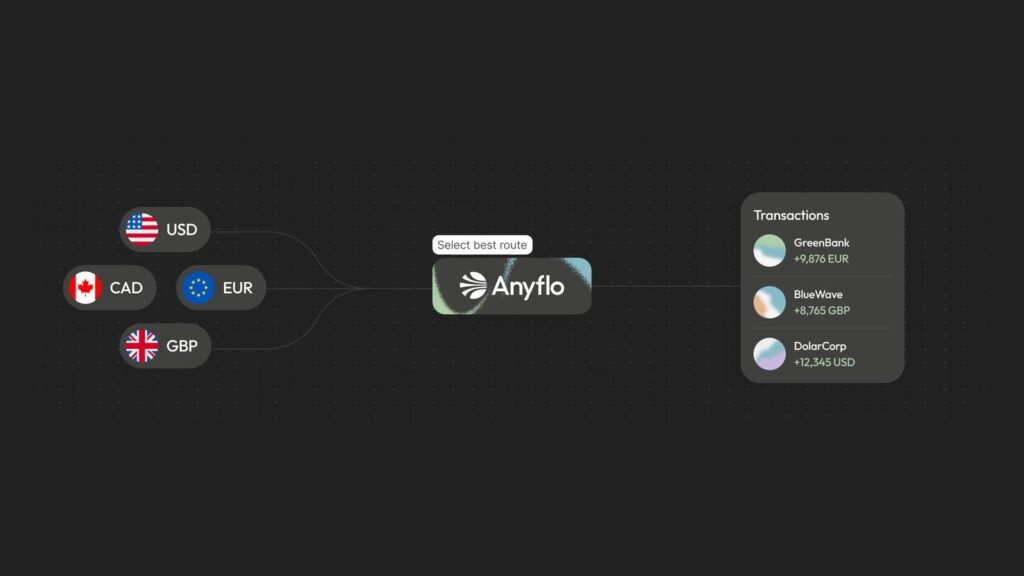
“Our model is an orchestrator,” she says. Each transaction generates an intent, Anyflo puts it out for bids, and a solver with a quote completes it. Testing with design partners and liquidity providers runs over the next three to four months.
In parallel, Anyflo is building its compliance posture and hopes to have an EU payments licence in the new year. She then expects a full launch, starting with payments between Europe and the African continent, then Asia.
The public record lines up. According to Anyflo’s press release on PR Newswire, the company emerged from stealth on 8 October 2026 at Sui Basecamp during Token2049 Singapore, after being incubated within Mysten Labs. It entered private alpha in October, with a beta planned for the first quarter of 2027. Pulse 2.0 reported that Mysten Labs invested $1 million and that Anyflo acqui-hired Native, a Bitcoin lending project on Sui that finished in the top five of 630 projects at Sui Overflow 2025.
“Token go up is not a business model”
Asked what her experience taught her, Lola makes a joke she says she means in good faith: “token go up is not a business model.” She calls it her biggest insight.
Very few people know how payments work, she says, pointing to India’s UPI as “a very, very sophisticated solution to a chronic problem” built on deep infrastructure. Her edge is that she understands that infrastructure. “When you understand how fiat rails work, and then you think about how do I connect fiat and stablecoin rails, you actually have a magic insight that very few people understand.”
Many blockchain teams have great cryptographers and developers, she says, but “unfortunately for them, they don’t know how fiat rails work”, or how to build a business model. “And so they have high potential, but limited reach.”
She does not overclaim. The proof, she says, will come when Anyflo starts scaling transactions. “We’re not naive about how difficult it’s going to be,” she adds. Compliance and regulation are areas Anyflo will not compromise on.
What changes for a business that uses Anyflo
Today, Lola says, a business offering cross-border payments is usually in one of two places. Either the service is expensive and “your customer feels like they have no choice”, or it is cheap and the business makes little profit for the effort.
The first change is a stablecoin sandwich that removes correspondent banking, settlement delays and other costs. At a baseline, she says, the business could raise its profitability and lower the cost to its users.
The second change is choice. Her example is payroll. Contractors hired overseas may have banking problems and would rather receive a stablecoin than local currency, which is hard for payroll companies to deliver.
“Give your customers a choice,” she says. With Anyflo, a business that offers rupees or dollars today could also offer stablecoin dollars, or stablecoin rupees if they exist in future, with the same effort. “We just make it a simple extra option for the business,” she says, and it gains either margin or customer value.
Will Anyflo get into cards?
Lola says many vendors on blockchain rails already specialise in stablecoin-backed card issuance, and Anyflo can tap that network. It will look at supporting “receive and spend”: an instant wallet, or a virtual bank account and an instant card.
The roadmap will follow customer demand. “We’re a small team, we’re agentically powered,” she says. Not every feature will exist on day one, but if a customer brings demand for cards, Anyflo will make it available.
Why Sui, and why Anyflo stays multi-chain
Given her Mysten Labs background, Ahmad asks what role Sui plays. Lola says Anyflo, as an independent orchestrator, can use any blockchain rails and has no fixed requirement to use Sui.
The practical case for Sui is cost. “The number one thing that Sui’s offering today that no other chain can match is zero gas on stablecoin transfers,” she says. “Taking gas out means that demand does not become a penalty on the business.” According to a Sui press release on PR Newswire, the network launched protocol-level gasless stablecoin transfers on 20 May 2026, taking fees for supported stablecoin transfers to zero. She also points to Sui’s native privacy features, which let Anyflo add services without extra vendors or cost.
If a customer needs a specific chain or asset, Anyflo will deliver it. If it only wants cheap, fast and reliable, she says Sui may be the right route nine times out of ten. “That’s the beauty of orchestrating,” she says. “I don’t lock you into one blockchain. I lock you into an outcome.”
Security: why no founder can promise never to be hacked
“I think it would be incredibly naive for any tech founder to say we will never be hacked,” Lola says. She adds that agentically powered development creates new risks as well as new benefits. She sets out what Anyflo does:
- “We’re fully audited for our alpha right now,” she says, and audits will continue.
- Engineering is led by Robert Zaremba, whom she describes as co-founder and CTO of Native, a Bitcoin collateralisation platform, and a developer who has worked with secure protocols on Near, Sui and EVM chains.
- Anyflo builds security first, with regular testing and review on top.
- Unlike an exchange, one customer’s money will not be mixed with other customers’ money or with Anyflo’s own.
That isolation keeps the damage surface very limited if something goes wrong, she says. Anyflo’s website FAQ adds that it is non-custodial, with funds held by regulated custody and banking partners in segregated accounts.
“You make best efforts, you follow best practices, and then you hope for the best. And then if something goes wrong, you react really well,” she says.
Why so few women reach the core of the industry
Ahmad’s last question is why so few women reach the core of the industry. Lola says she cannot give a reason. She can speak to her own career: leaders who invested in her, and “powerhouse women” she reported to who showed her what it is like to be a CEO.
That built her confidence. “I’m not doing this as a female, but I happen to be a female. I happen to be a mother. I happen to be a wife,” she says. “It’s not about having it all. It’s about just doing the thing that you’re most passionate about.”
She suggests society sometimes gives men more freedom to focus on their passion. With a rich network and strong female role models, starting with her mother, the only questions for her were the right idea, experience and plan. She believes those have come together with Anyflo. “So, we’re just getting on with the job.”
Final thoughts
The interview makes a practical case. Lola is not saying businesses should want stablecoins for their own sake. She is saying stablecoin rails only help if they come with what businesses already rely on: compliance, clear receipts and fiat at both ends.
Much of this is still a plan. Anyflo is in private alpha, no partners are transacting fully, and the EU licence and full launch are targets. Her points on cost savings and Sui’s lead are her own views. The real test, as she says, will come when Anyflo starts scaling transactions.
Watch the full conversation on the TBP Podcast YouTube channel.
Frequently Asked Questions
Q: What is Anyflo?
Anyflo is a stablecoin payments orchestration company led by founder and CEO Lola Oyelayo-Pearson. It offers businesses one API to send and receive cross-border payments in their preferred currency, settled on stablecoin rails. It was incubated within Mysten Labs and emerged from stealth in October 2026.
Q: What is a stablecoin sandwich?
A cross-border payment that starts in fiat, crosses the border as a stablecoin and ends in fiat, so neither side has to hold stablecoins.
Q: Is Anyflo live?
Not fully. Lola says Anyflo is testing with design partners and liquidity providers and hopes to secure an EU payments licence in the new year. Its press release says it entered private alpha in October 2026, with a beta planned for the first quarter of 2027.
Q: Does Anyflo only work on Sui?
No. Lola says Anyflo is a multi-chain orchestrator with no fixed requirement to use Sui. Sui’s zero-gas stablecoin transfers make it a frequent choice, but Anyflo will use other chains when a customer needs them.
Q: How does Anyflo approach security?
Lola says the alpha is fully audited and each customer’s funds are kept apart from other customers’ and from Anyflo’s own money. She says no founder can promise never to be hacked.
Q: Which payment corridors will Anyflo serve first?
Lola says Anyflo plans to start with Europe and the African continent, then expand to Asia. This is a company plan, not a launched service. This article is not financial advice; stablecoins carry risks, so check licensing and terms before moving money.